I first started thinking about assessment accessibility through conversations with students who were trying to make sense of their own results.
Again and again, I was working with children and young people whose understanding was far stronger than their written work suggested. They could explain an idea in discussion, notice the important point in a text, talk through a process, or answer questions when the task was broken into smaller parts, but when the same understanding had to be shown through a formal written task, the result could look very different.
For the student, that difference can feel brutally simple. The mark says they did not do well. The feedback says the answer was incomplete. The comparison with others says they are behind. Over time, those experiences can harden into a much larger story: I am bad at tests. I cannot write. I do not know how to explain things. I am not as able as everyone else.
What interested me, and troubled me, was how often that story was not quite true.
Many students who struggle with assessment do not come to the task neutrally. They bring previous marks, previous misunderstandings, previous comparisons, and sometimes years of feeling that schoolwork keeps proving something painful about them. A new assessment can therefore feel like more than a task. It can feel like another occasion on which failure might be confirmed.
In that context, the adult response is important. If the conversation begins with judgement, the student may protect themselves by shutting down, saying they do not care, blaming themselves quickly, or agreeing that they “just can’t do it”. A more useful starting point is curiosity. Instead of treating the result as a verdict, I try to approach it with the student as something we can investigate together.
The question becomes not, “Why didn’t you do better?” but, “What happened here?”
When I slowed tasks down with students in that spirit, we often found that the assessment had measured much more than the knowledge or skill named in the objective. It had also measured the student’s ability to read and hold instructions in mind, organise ideas quickly, tolerate uncertainty, manage time pressure, write at length, spell while thinking, begin without reassurance, and understand what kind of answer was expected.
Those demands are not always visible in the final mark. They sit behind the result, shaping it, while the score itself appears to offer a clear judgement. A student who writes very little may look as if they know very little. A student who misses part of an instruction may look careless. A student who freezes at the start may look unprepared. A student who gives a vague answer may look as if they have not understood, when they may simply be unsure how much detail the task requires.
This is where assessment can become particularly difficult for autistic students, dyslexic students, students with ADHD, students with language needs, and students who experience anxiety around open-ended tasks. The problem is not only that the assessment is hard, but also that the source of the difficulty can be misread. The student’s knowledge and the route they are given to show that knowledge become tangled together.
To help guide my conversations, I began using a simple grid. At first, it was not designed as a resource for teachers but was rather a way of helping students look back at a task and separate out what had actually happened.
Instead of asking, “Did I get this right or wrong?” we explored the question, “What was this task asking of me?”
The assessment grid
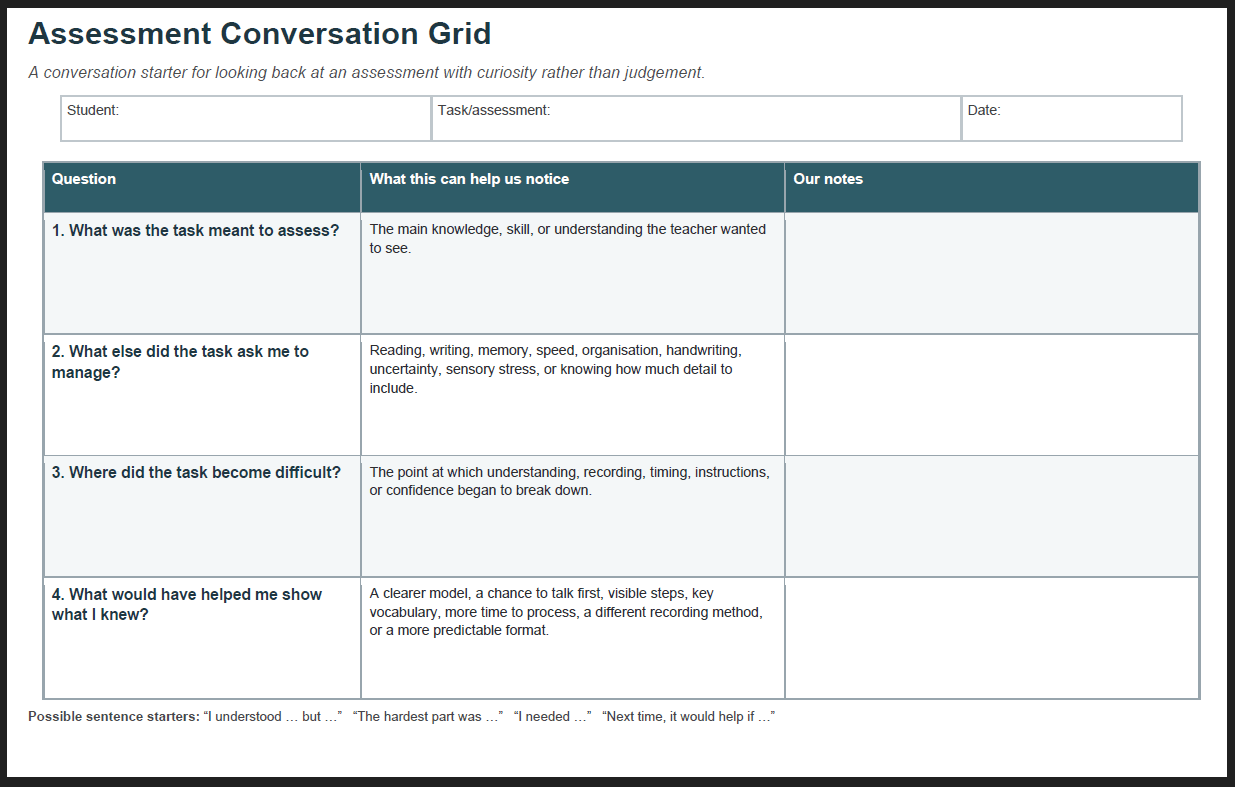
The value of the grid is that it changes the conversation. A low mark can feel global and fixed, as if it says something settled about the student’s ability. The grid makes the difficulty more specific. It allows the student to say, “I understood it when we talked about it, but I did not know how to organise it in writing,” or “I knew the answer, but I did not know how much detail to include,” or “I lost track because there were too many steps.”
Those are very different statements from “I cannot do this.” They are also much more useful.
Over time, I realised that the same grid could be adapted for teachers. If it helped students see the hidden demands in an assessment, it could also help teachers notice those demands before the task was used. What began as a conversation starter with students gradually became an audit tool for assessment planning.
The teacher version asks the same underlying question from the other side: what is this assessment really measuring? It can be used to consider whether the task is assessing the intended knowledge or skill, or whether the result may also be shaped by reading load, writing load, timing, memory, recording method, sensory conditions, or uncertainty about the format.
The aim is to make the assessment more accurate rather than to remove challenge or lower expectations. When the hidden demands are left unexamined, there is always a risk that we mistake barriers for lack of ability, or assume that a student has not understood something when they have simply been unable to show it through the route provided.
Assessment should help us understand learning more clearly. The grid is an attempt to make that process more careful, more curious, and more humane.
Downloadable grids
I have created two versions of the grid.
[Download the student conversation grid as a PDF]
This version is designed to be used with students after an assessment or written task. It can help open a conversation about what the task was asking of them, where it became difficult, and what might help next time.
[Download the teacher assessment audit grid as a PDF]
This version is designed for teachers to use when planning or reviewing assessments. It focuses on the hidden demands within the task and can help identify adjustments that make assessment more accessible without reducing the expectation.
If you’re interested in how these ideas connect to inclusive English teaching in practice, you may also like my post on supporting autistic girls in the classroom, or the resources I’ve developed for teaching neurodivergent learners.
One thought on “What Is an Assessment Really Measuring?”
Comments are closed.